Real Fiction
Problem Space
In our interpretation of the Immersive Education design brief, we have identified student clubs and societies as an area for which to design an immersive experience. The University of Sydney Union (USU) is an independent student led organisation which plays a key role at the University of Sydney, drawing together numerous extracurricular social groups which cater to the diverse tastes of the student body.
We propose to build an immersive experience which enables students to better experience a sample of the many USU clubs and societies on offer and to determine which might appeal most to them. In addition, key information about select on campus locations will be imparted to the users of this service. Although this application can be used by all students, our key target users are International Students for whom participation in USU clubs and societies may offer the most benefit.
International students also face additional obstacles to participation for a range of reasons including cultural and linguistic barriers and challenges associated with adjusting to the new environment of their host country. These barriers are especially felt during their first year of study.
Concept Iteration
Throughout the ideation process and development of our core concept, multiple iterations lead to refinements, or abandonment of certain directions, leading the team to our final proposal.
The proposal evolved in the following ways:
Initial concept of a virtual immersive database for browsing student clubs and societies was refined to add the simulated campus environment which eases the students to the University environment and passively teaches them the spatial relationship between key locations.
Background research and consideration of user needs led the team to refine our target users as International Students, rather than the full spectrum of the student base.
360° video was incorporated into design concept in order to provide realistic content which is useful for the student to evaluate social scenarios while also reducing overhead costs by avoiding the need to generate overly complex virtual scenes.
Details of Intended Prototype
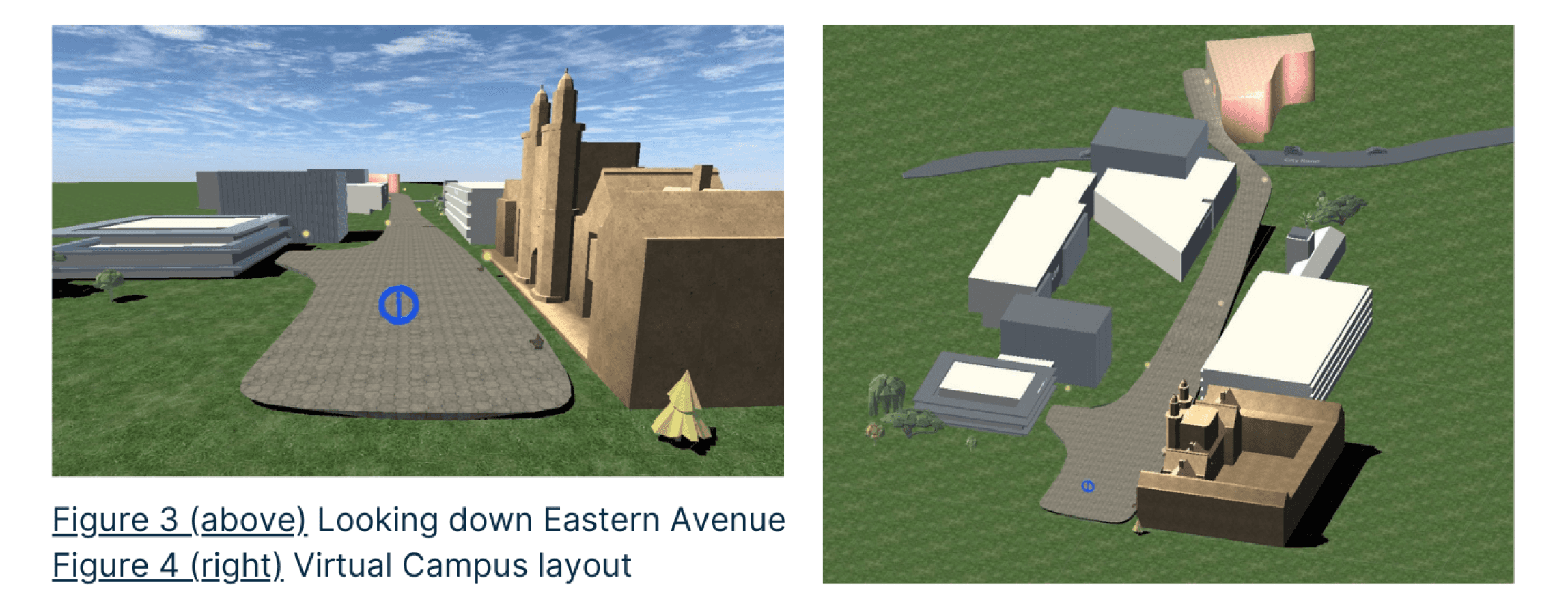
Beginning the experience, users will find themselves in a simulated VR space presenting them with a stylised portion of the University of Sydney Campus. Created in Unity, this virtual reality environment will consist of three main locations:
The Quadrangle
Eastern Avenue and City Road Footbridge
The Wentworth Building
These three locations have been chosen in order to provide a starting place that is central to USYD and iconic (The Quadrangle), a corridor route through main campus with some significant locations (eg. Fisher library) and a ‘destination’ to reach which is of significant to the USU and International Students (The International Student Lounge located in the Wentworth building).
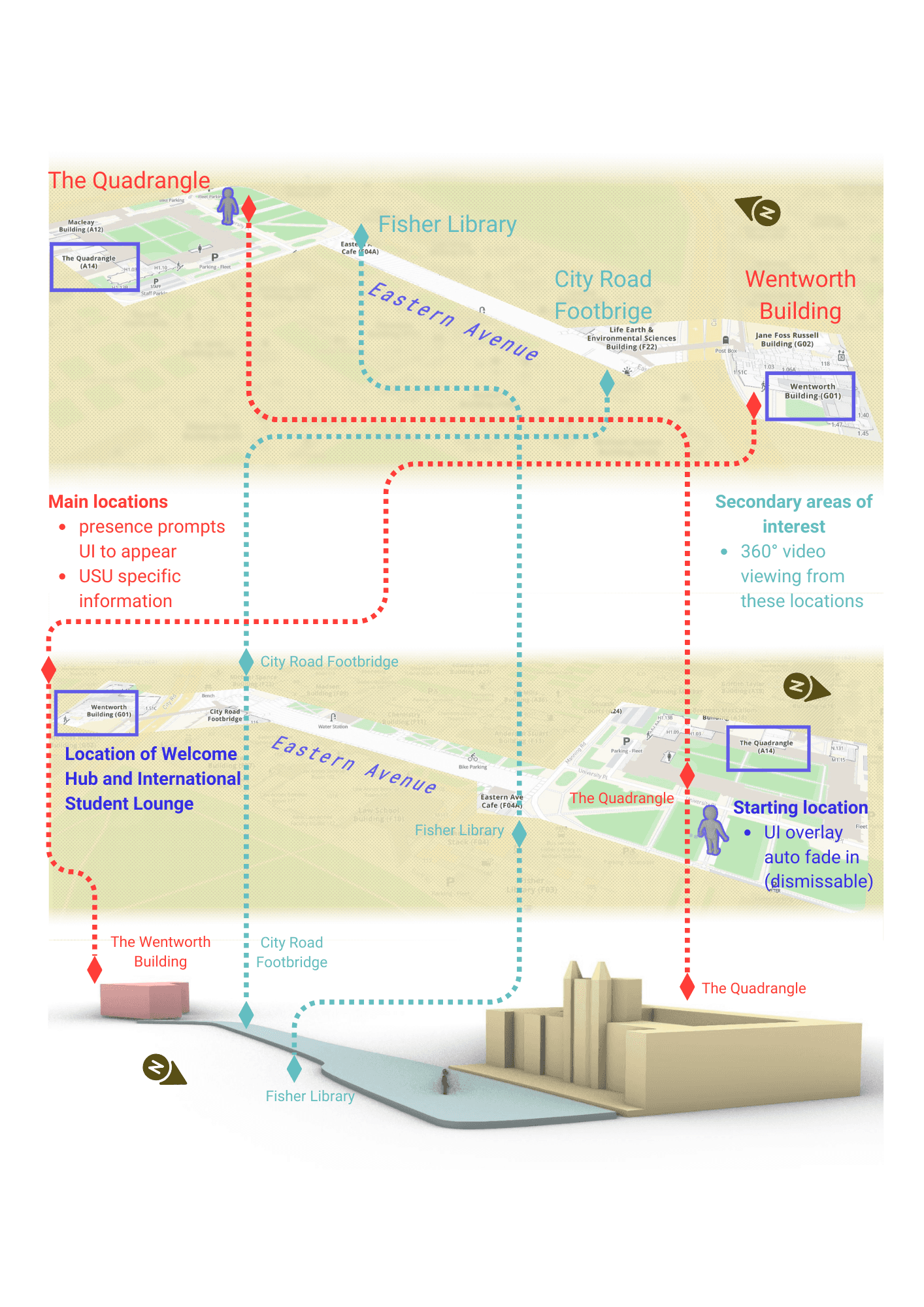
At The Quadrangle as their starting location, a floating interface will appear between the user and the building, situated in their central field of view. This will emerge after a short delay allowing for an impression of the virtual environment to reach the user before they are prompted to engage with a menu. Efforts will be made to ensure that the user has a chance to detect there is more to the environment within their peripheral field of vision. From this beginning moment, the user can explore the Interface or choose to dismiss it and explore the environment instead. This UI can be summoned again as desired.
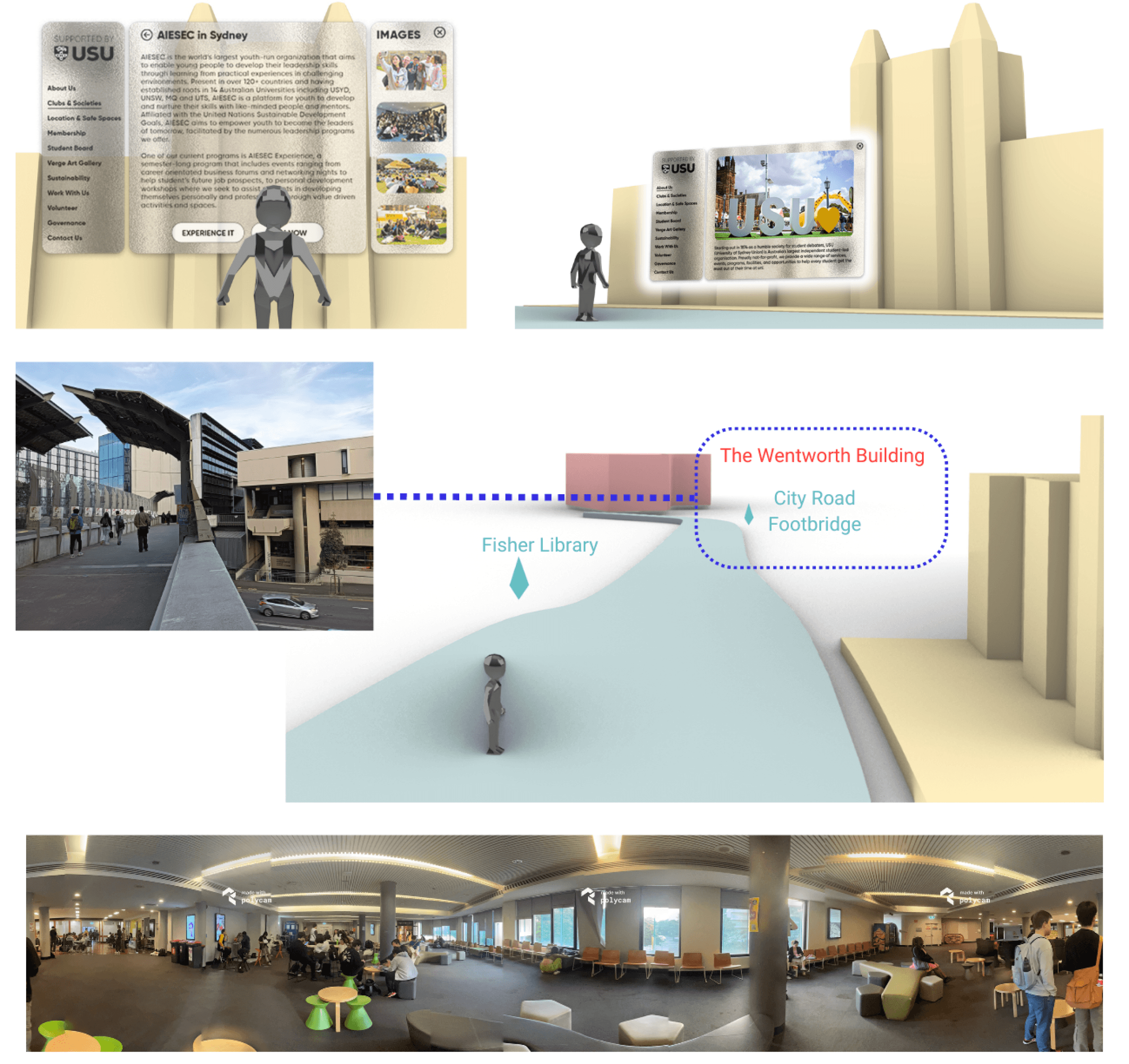
A combination of interactivity and sense of immersion in a 3D environment will be achieved in this early stage of the user journey. Should the user wish to start discovering clubs and societies, selecting the option to experience a given club will transition them to a 360° video recording of that scenario.
Following the path which leads to another building in the distance, the user will encounter floating objects of interest which provide access to 360° video scenes depicting significant campus locations such as Fisher Library.
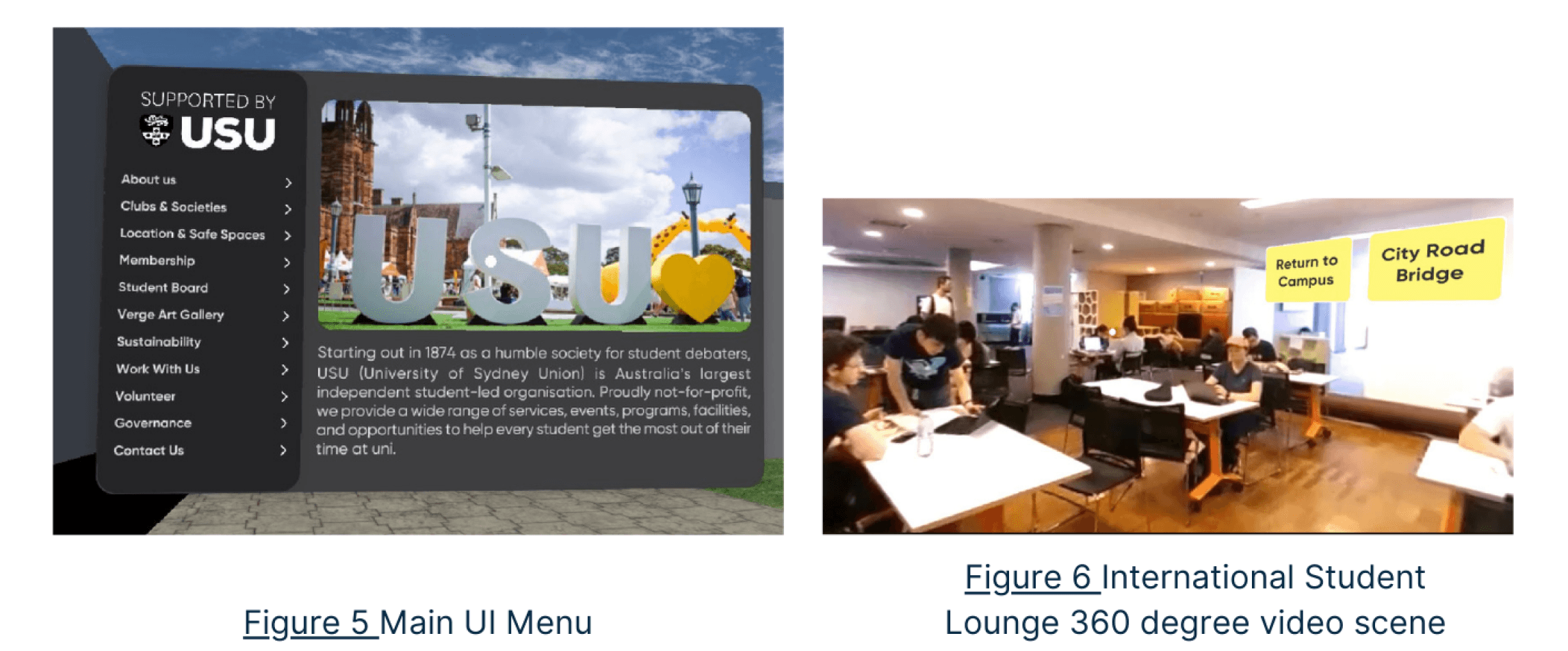
Reaching the Wilkinson Building, the student will be introduced to the International Student Lounge - the premier USU campus location and a ‘safe space’ dedicated to International Students.
The International Student Lounge in the Wentworth Building is the destination reached as the user follows Eastern Avenue to the Wentworth Building.
Final Prototype
Our design concept is a VR app: the USU Clubs and Societies Virtual Experience, tailored towards the needs of International students. Its goal is to give international students access to a slice of life at the University of Sydney Camperdown campus through clubs and societies available for them to join through the University of Sydney Union (USU). The app will be available for students both within and outside the country. Users have the option to explore and experience the USU and its clubs and societies or can choose to navigate the 3D virtual space: a replica of the University of Sydney Camperdown campus.
User Experience - Journey
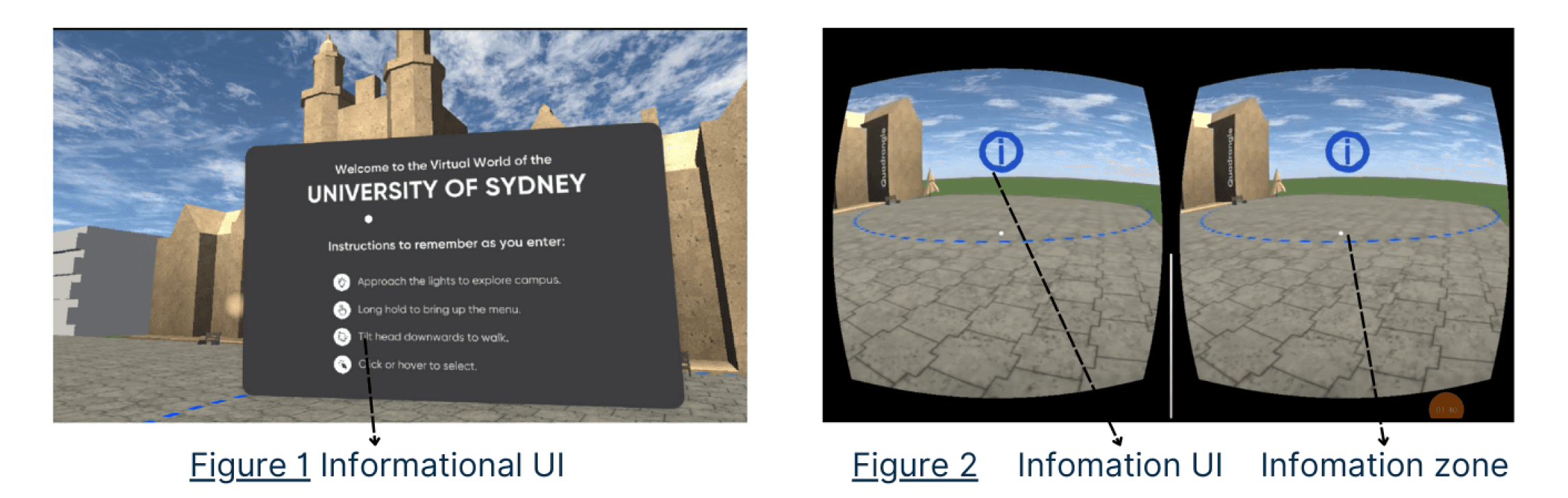
Upon wearing the VR headset, the user is welcomed by the sound of a bustling campus. They can interact with buttons within the VR world by facing them with the help of a reticle. Within their line of sight is an informative UI element offering a set of instructions that will help users navigate the experience (figure 1). These instructions include:
Approach the lights to explore the campus
Long hold to bring up the menu
Tilt head downwards to walk
Click or hover to select
The user can find the instructional UI again by returning to a location marked with a floating blue information icon that opens on approach.
User Experience - Virtual Campus
When the user chooses to explore the university campus, they can move around Eastern Avenue, where they will be guided by yellow spotlights indicating key locations within the University. Upon proximity to these spotlights, they turn into floating “banner buttons” naming that specific location within the campus. Using the reticle on these banner buttons, access is given to a 360 degree video of the location, allowing a truer experience of the environment.
User Experience - Clubs, Societies, & Safe Spaces
To explore USU clubs, societies, and safe spaces, the user is required to “long press” the Google cardboard, and the main UI element will appear. A long press was implemented as the ideal way for the user to call up the main menu from any location as needed, with the UI appearing before them, and to retain short button presses for regular click interactions.
The main UI menu gives users the option to experience or join different clubs societies and safe spaces within the USU. The selection is made with the reticle. Clubs and societies are categorised in a persistent navigation pane.
Users can navigate to any club that piques their curiosity. They will then be able to use the reticle to hover over clubs, societies and safe spaces of interest and will be transported to immersive 360 videos of these experiences.
Final Prototype - Video Tour

The video below gives you a tour of our final Virtual University of Sydney campus and the locations listed above by the USU. This is a promotional video which could potentially be used by the university, if this concept gets approved.
Reflection
The creation of the VR app was an exciting and challenging group project that gave insight into teamwork, Virtual reality principles, design, and technology. It allowed us to tackle a problem area that resonates with each of us. Key takeaways from this include:
Collaboration: Working in a team highlighted the importance of effective communication, division of tasks, and mutual support. The diversity of skills and perspectives within our group contributed to our interpretation of the design brief.
Innovation, Design, and Creativity: Developing the VR app gave us the opportunity to explore creativity within the virtual reality space and technology. We were challenged to think outside the box and consider our target users in our design decisions. It was a chance to experiment with new technologies and explore novel design concepts.
Technical: The project allowed us to engage with course materials and apply them to our designs. Overcoming challenges during the design process gave us an appreciation for persistence an problem-solving.
Other Projects